> For the complete documentation index, see [llms.txt](https://enterprise-docs.datacamp.com/llms.txt). Markdown versions of documentation pages are available by appending `.md` to page URLs; this page is available as [Markdown](https://enterprise-docs.datacamp.com/data-connector-1.0-documentation/data-connector-1.0-getting-started/data-connector-1.0-your-credentials.md).

# \[Data Connector 1.0] Your Credentials

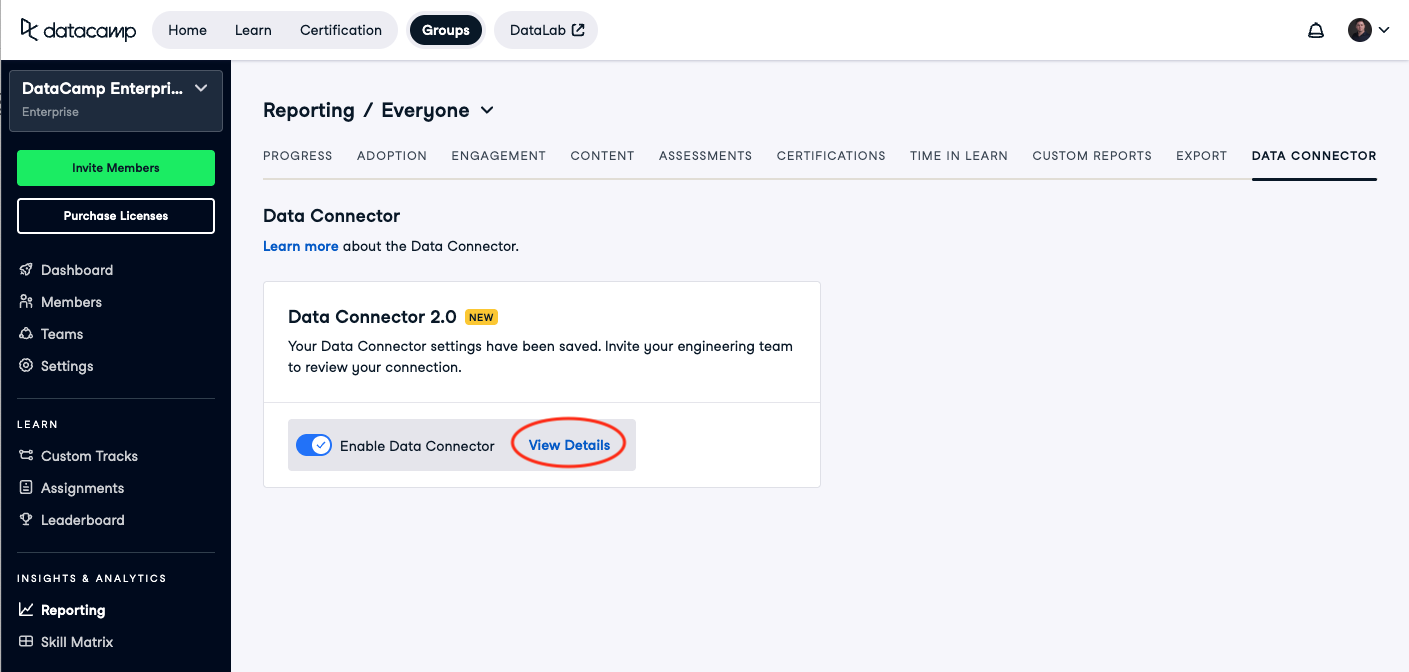
**Step 1:** Navigate to the Reporting section (on the left-hand panel) and select the **Data Connector** tab at the top of the page.

<figure><img src="/files/bLCG2EfJSd4YQKwa5SsA" alt=""><figcaption></figcaption></figure>

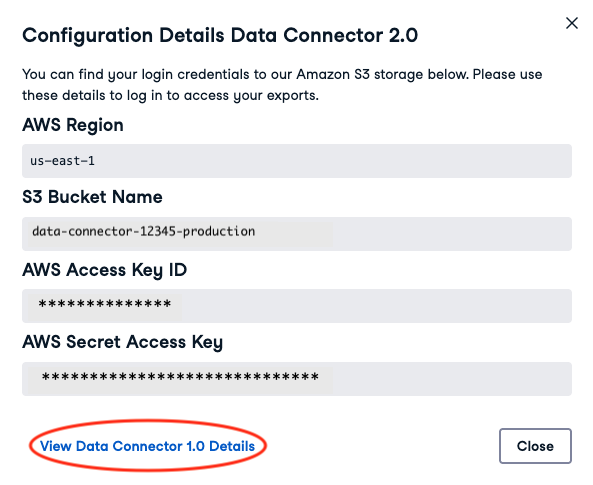
**Step 2:** Click **View Details**.

{% hint style="danger" %}
The first modal will show you your Data Connector 2.0 credentials. To see your Data Connector 1.0 credentials please click on **View Data Connector 1.0 details.**\
\
We highly encourage to consider migrating to Data Connector 2.0. For more details please see the [Migrating from Data Connector 1.0](/integrating-our-data-into-your-tools-via-data-connector-2.0/migrating-from-data-connector-1.0.md) section
{% endhint %}

<figure><img src="/files/vqyW14Z9sq4Ei1z9xqvi" alt=""><figcaption></figcaption></figure>

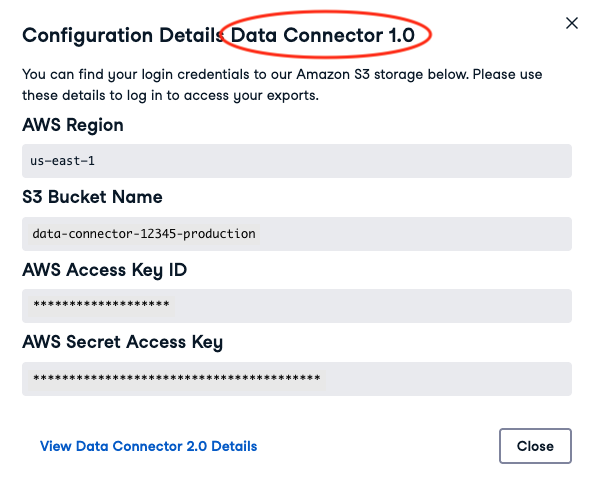
**Step 3:** View your credentials in the **View Data Connector 1.0 Details** dialog.

<figure><img src="/files/FOhqGFFuumJLejHiu77E" alt=""><figcaption></figcaption></figure>

<table><thead><tr><th width="226.34945131434415">Value</th><th>Description</th><th>Example</th></tr></thead><tbody><tr><td><strong>AWS Region</strong></td><td>This is the location in the world where the Amazon data center cluster is located. That is the place where your data is stored.</td><td><code>us-east-1</code></td></tr><tr><td><strong>S3 Bucket Name</strong></td><td>This is the name of the storage resource containing your data</td><td><code>data-connector-12345-production</code></td></tr><tr><td><strong>Access Key</strong></td><td>This is a username for you to access the S3 bucket. It consists of 20 upper case letters</td><td><code>QOXGBQHVDLYJPCFFKOAE</code></td></tr><tr><td><strong>Secret Password</strong></td><td>This is a password for you to access the S3 bucket. It consists of 40 alphanumeric characters.</td><td><code>HUUOTPJNTJKNLWIYCKPQPDDOXAISQSTRSVDXARUD</code></td></tr></tbody></table>

{% hint style="warning" %}
If you are using an Amazon Athena library you might be required to enter a **staging or output directory**. This is a special directory in the S3 bucket that is writable by the Athena library and is used to store output files for your queries.

Use the following value for your output directory

<mark style="color:orange;">`s3://{YOUR_S3_BUCKET_NAME}/tmp-tableau/athena/`</mark>
{% endhint %}


---

# Agent Instructions
This documentation is published with GitBook. GitBook is the documentation platform designed so that both humans and AI agents can read, navigate, and reason over technical content effectively. Learn more at gitbook.com.

## Querying This Documentation
If you need additional information that is not directly available in this page, you can query the documentation dynamically by asking a question.

Perform an HTTP GET request on the current page URL with the `ask` query parameter, and the optional `goal` query parameter:

```
GET https://enterprise-docs.datacamp.com/data-connector-1.0-documentation/data-connector-1.0-getting-started/data-connector-1.0-your-credentials.md?ask=<question>&goal=<endgoal>
```

`ask` is the immediate question: it should be specific, self-contained, and written in natural language.
`goal` is optional and describes the broader end goal you are ultimately trying to accomplish on behalf of the user. GitBook uses it to tailor the answer towards what is most useful for that goal.

The response will contain a direct answer to the question and relevant excerpts and sources from the documentation.

Use this mechanism when the answer is not explicitly present in the current page, you need clarification or additional context, or you want to retrieve related documentation sections.